Why Loudspeakers Fail, and How to Stop It Happening
06 Oct 2026
Choose a 6-inch driver for car doors and compact 2.1 systems, 8 to 10 inch for small rooms and entry home theatre, and 12 inch as the most versatile size across home theatre bass, DJ mid-bass and small PA. Go to 15 or 18 inch for large DJ and event bass. Size is only a starting point: excursion, resonance, cabinet volume and sensitivity determine the result.
Size is the first number on every carton, so buyers often treat it as the whole decision. A 12-inch driver can be a home theatre subwoofer, a DJ mid-bass unit or a small PA woofer, and those are three different designs. Two 12-inch drivers can behave very differently depending on resonance, sensitivity, excursion and the cabinet they sit in.
This guide is written by a transducer manufacturer in Kolkata. It explains the difference between a woofer and a subwoofer, what each size does well, where each runs out, and how to choose for your application using measured parameters from our own catalogue. Where a point is industry practice rather than a Sweton specification, we say so.
A woofer reproduces bass and lower-midrange. A subwoofer reproduces only the lowest octaves, usually below about 100 to 120 Hz, and needs a crossover to keep everything else away from it. A woofer is usually part of a complete speaker; a subwoofer is the dedicated bass unit that sits beside it.
There is a third category that most comparisons miss, and it matters in professional audio: the mid-bass driver. It sits between the two, covering upper bass and lower midrange in a multi-way system, and it is built differently again.
| Category | Band it covers | Built for | Typical excursion | Crossover | Sweton example |
|---|---|---|---|---|---|
| Subwoofer | Lowest octaves only, below roughly 120 Hz | Maximum excursion | Long | Always | Home Subwoofer Series |
| Woofer | Bass through lower midrange | Balance of extension and range | Moderate | Usually | Home Woofer Series |
| Mid-bass | Upper bass into midrange | Output and efficiency across a wider band | Short | Always | PT, IT and PA Series |
This three-way distinction is why the rest of this guide is not a simple ladder of sizes. A 10-inch mid-bass and a 10-inch home woofer share a diameter and very little else.
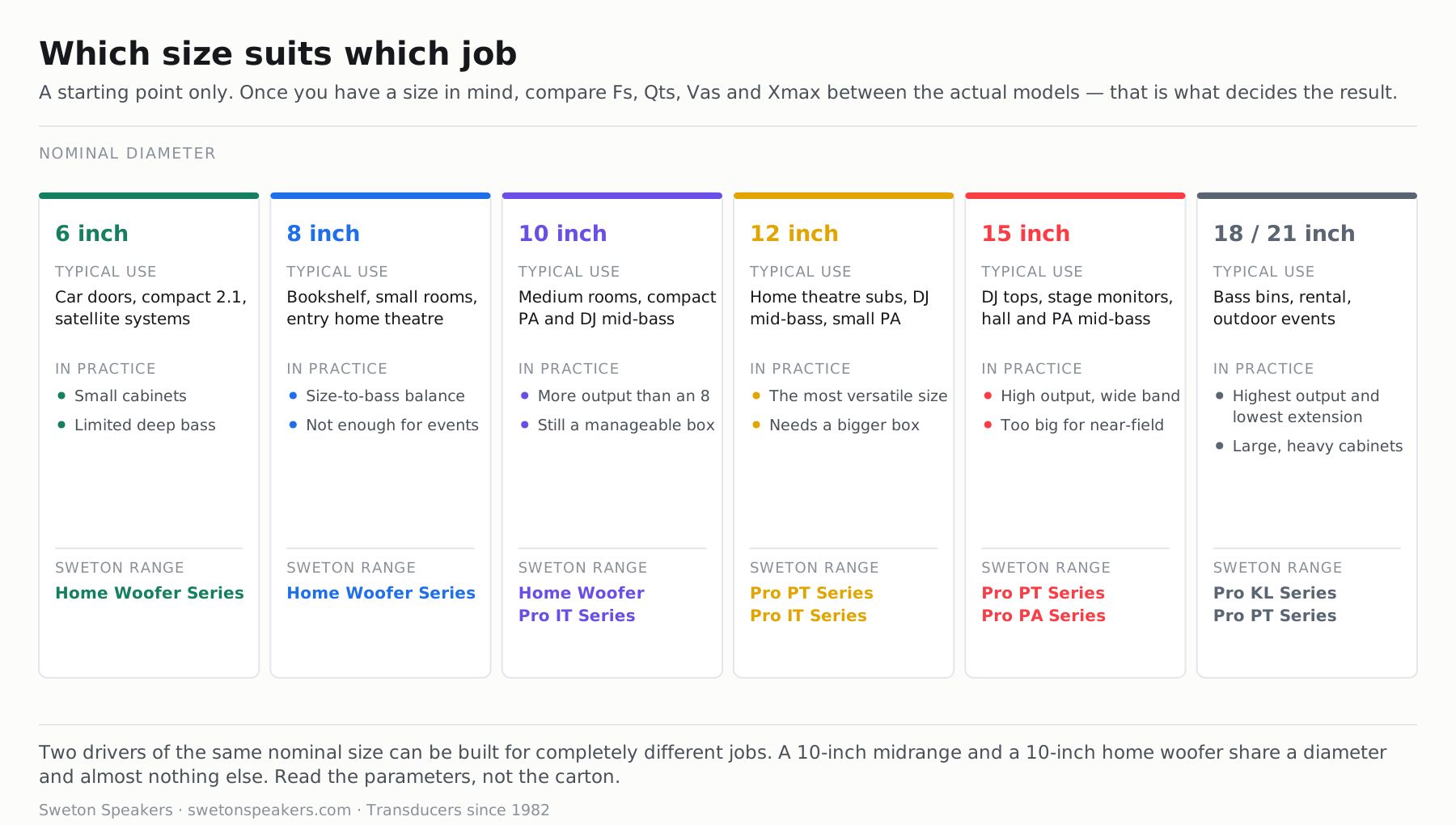
| Size | Typical use | Strength | Limitation |
|---|---|---|---|
| 6 inch | Car doors, compact 2.1 systems, satellites | Small, light, easy to fit | Limited low-frequency output and extension |
| 8 inch | Bookshelf systems, small rooms, entry home theatre | Good balance of size and bass | Not enough output for large rooms or events |
| 10 inch | Medium rooms, home theatre, compact PA and DJ mid-bass | More output than an 8, still a manageable box | Less deep than a 12 and larger |
| 12 inch | Home theatre subs, DJ mid-bass, small PA, installs | The most versatile size across applications | Needs a larger cabinet than a 10 for real bass |
| 15 inch | DJ tops, stage monitors, hall and PA mid-bass | High output across a wide band | Too large for near-field listening |
| 18 and 21 inch | DJ bass bins, rental, outdoor events | Highest output and lowest extension | Large, heavy cabinets and higher amplifier power |
That table is general industry practice, not a Sweton specification. It is a reasonable place to start. The next sections are where it stops being reliable.
The number that predicts bass output is not diameter. It is displacement — how much air the cone pushes in one stroke. It is cone area multiplied by linear excursion:
Here is that figure calculated for seven of our own drivers, using the parameters published on each product page:
| Size | Model | Sd (cm²) | Xmax (±mm) | Vd (cm³) | Fs (Hz) | Qts |
|---|---|---|---|---|---|---|
| 6 in | 6" Woofer 100 WT | 132 | 5.31 | 70 | 68 | 0.72 |
| 8 in | 8 IT 201 MB | 227 | 1.50 | 34 | 68 | 0.33 |
| 10 in | 10 IT 500 MB | 363 | 1.50 | 55 | 87 | 0.37 |
| 12 in | 12 PT 600 MB | 523 | 4.20 | 220 | 64 | 0.39 |
| 15 in | 15 PT 1000 MB | 876 | 6.20 | 543 | 45 | 0.36 |
| 18 in | 18 PT 1500 SUB | 1238 | 10.96 | 1357 | 45 | 0.39 |
| 21 in | 21 PT 3000 SUB | 1698 | 13.75 | 2335 | 31.8 | 0.29 |
Vd is calculated here as Sd × Xmax from each model’s published parameters. We state the method because the convention is not consistent across the industry, and a figure without a method is not comparable.
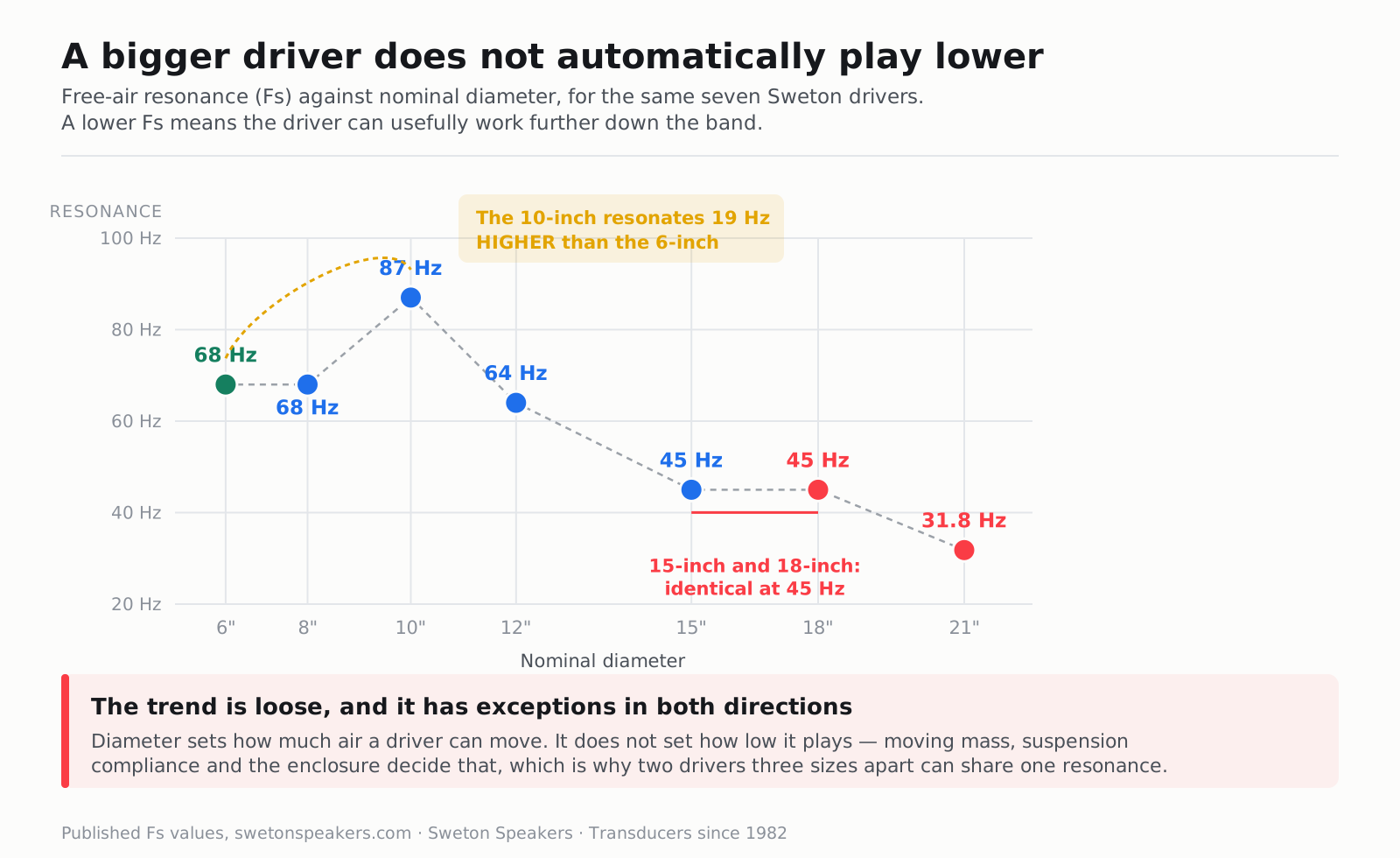
Look at the first and third rows of that table. The 6-inch displaces 70 cm³. The 10-inch displaces 55 cm³. The 10-inch has nearly three times the cone area and still moves less air.
The reason is in the Xmax column. The 10 IT 500 MB is a professional mid-bass driver, built to reproduce from 87 Hz upward in a multi-way system. It never needs to travel far, so it has ±1.5 mm of linear excursion and a light moving mass that buys it 97 dB of sensitivity instead. The 6" Woofer 100 WT is built to make bass in a small home cabinet, so it travels ±5.31 mm.
The job a driver was designed for tells you more than its diameter does. Neither of those two drivers is better than the other. They were built for different work, and a specification sheet makes that obvious once you know which columns to read. Comparing drivers on diameter and watts alone will mislead you.
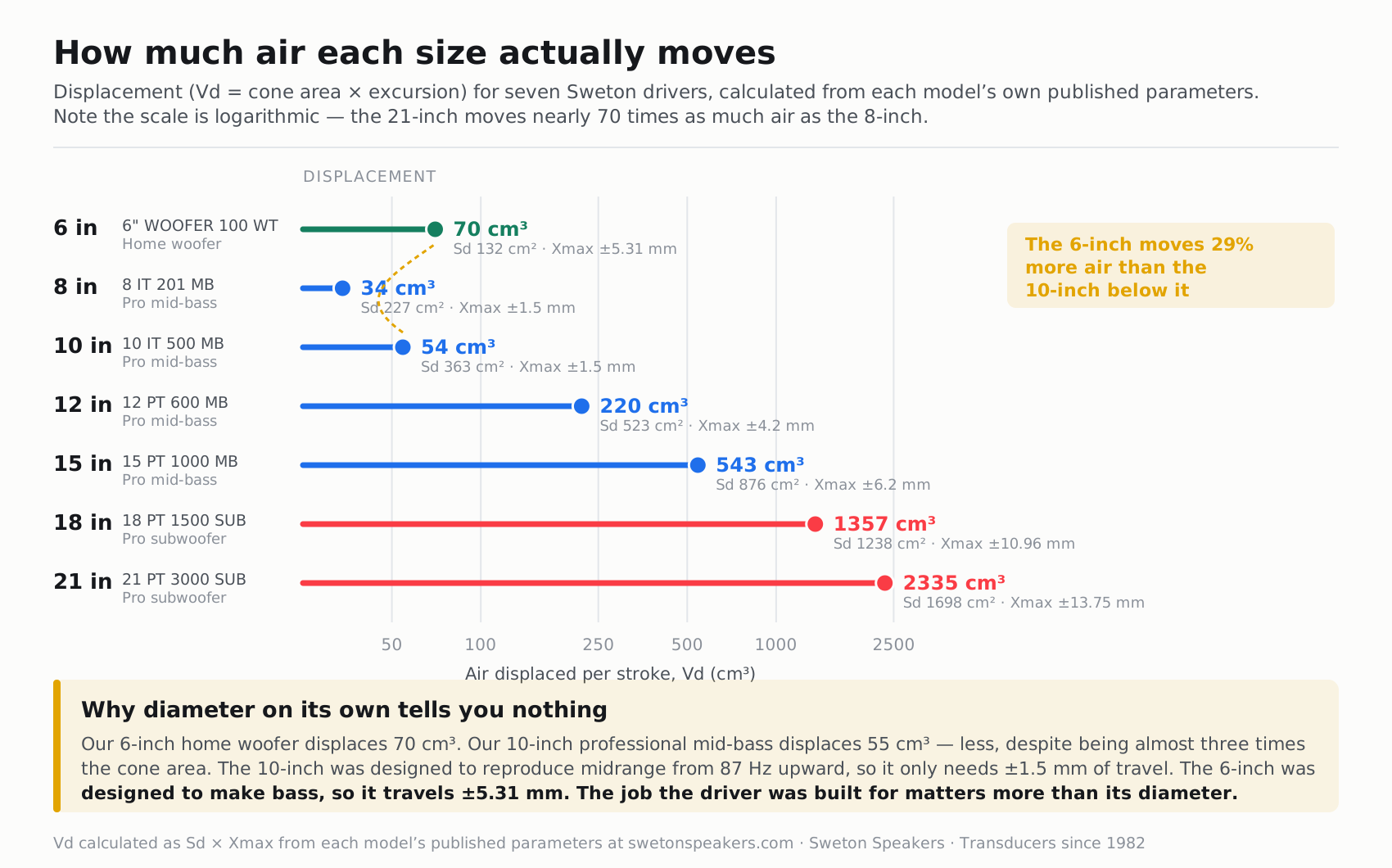
Loosely, and with exceptions in both directions. Free-air resonance (Fs) indicates how low a driver can usefully work. Across our own range it broadly falls as diameter rises — and then does not.
| Comparison | What our figures show |
|---|---|
| 10-inch against 6-inch | 87 Hz against 68 Hz. The 10-inch resonates 19 Hz higher, despite being far larger. |
| 15-inch against 18-inch | 45 Hz and 45 Hz. Identical, three inches apart. |
| 21-inch against 18-inch | 31.8 Hz against 45 Hz. Here the larger driver reaches materially lower. |
Diameter sets how much air a driver can move. Moving mass, suspension compliance and the enclosure set how low it plays. Those are separate design decisions, which is why two drivers three sizes apart can share a resonance.
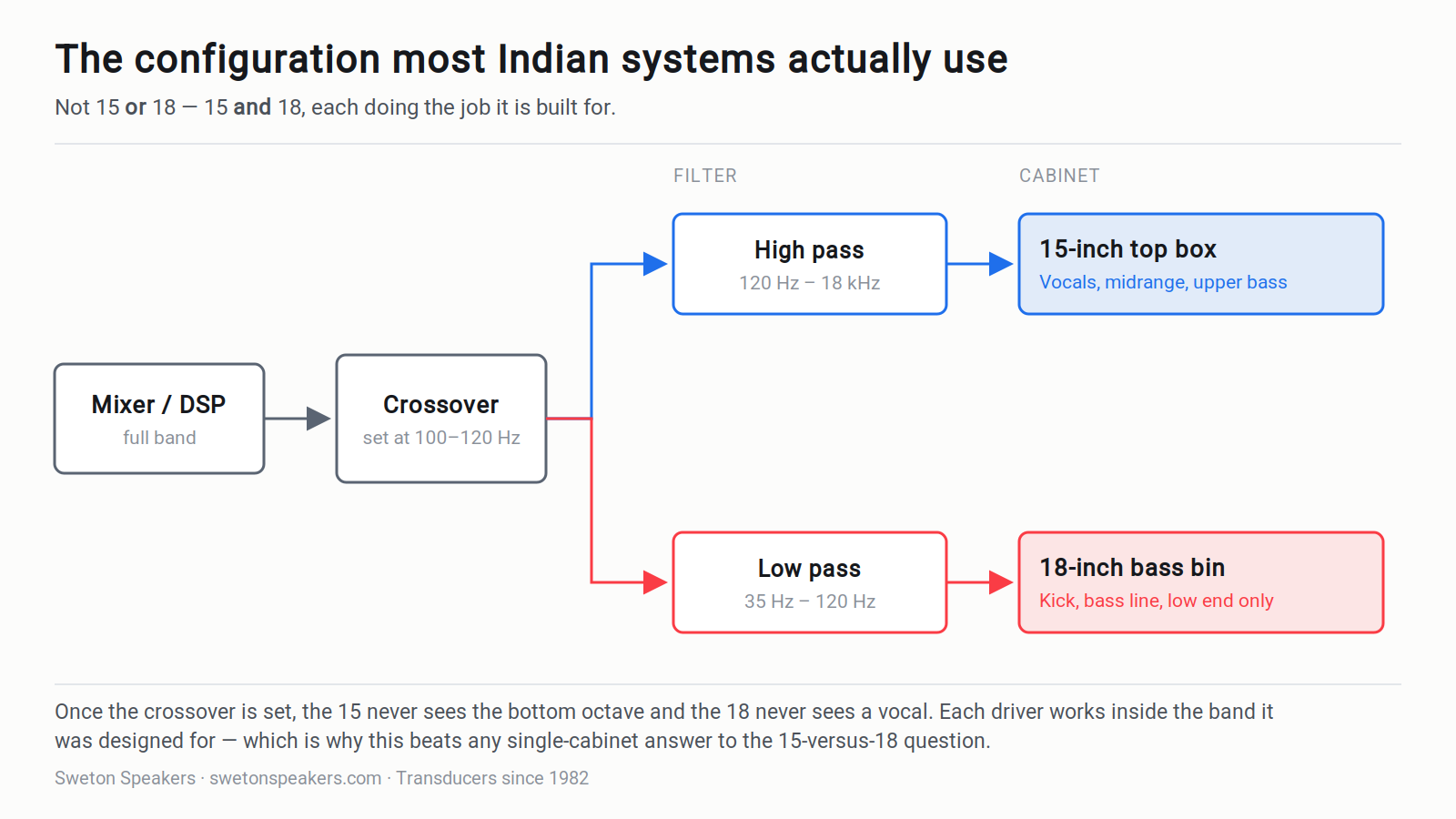
For more detail, including the decibel arithmetic, see our guide to 15-inch vs 18-inch drivers.
For most buyers who are not building a large DJ rig, yes. A 12-inch gives a good balance of output, extension and cabinet size. But “12 inch” covers two quite different designs:
| Design | 12 inch for home theatre | 12 inch for DJ and PA |
|---|---|---|
| Goal | Deep, controlled bass at moderate level | Punch and high output over long hours |
| Design focus | Low resonance, long excursion, tight control | Higher sensitivity, heat capacity, robustness |
| Typical cabinet | Sealed or small vented box | Vented box with a high-pass filter |
| Amplifier | Modest power | Higher power, with a limiter |
| What to read | Low Fs, high Xmax, Qts near 0.4 or above | High sensitivity, large voice coil, high AES rating |
Our 12 PT 600 MB is the professional version: 523 cm² of cone, ±4.2 mm of travel, 95 dB sensitivity, 600 W AES and a 99.3 mm voice coil for heat capacity. It is a mid-bass driver, not a subwoofer, and its 64 Hz resonance tells you so.
| Specification | In plain terms | Why it matters |
|---|---|---|
| Sd — cone area | How much air the cone pushes on | The working area. Read it rather than the nominal diameter. |
| Xmax — linear excursion | How far the cone moves before it distorts | With Sd it sets maximum clean bass output. |
| Vd — displacement | How much air it moves in one stroke | A useful predictor of low-frequency output. |
| Fs — resonance frequency | Where the driver naturally wants to vibrate | Sets how low it can usefully go in a given cabinet. |
| Qts and Vas | How the suspension behaves, and what box it needs | Together they help determine cabinet size, type and tuning. |
| Sensitivity | How loud it goes per watt | Sets how much amplifier power you need. |
| Rated power and test standard | How much heat it survives, and how that was measured | Only comparable if the test method is stated. |
Nominal power is measured to AES2-1984. Program power is defined as 3 dB above nominal. Thiele-Small parameters are measured after a high-level 25 Hz sine-wave preconditioning test lasting four to eight hours, which settles the suspension before anything is recorded. Linear Xmax is measured by mechanical excursion. Frequency response and impedance are measured on a CLIO 12.5 system.
The full method is on our test standard page. If another manufacturer does not publish its method, its numbers are not comparable with ours—and that is the first question to ask.
This is the question most sizing guides skip, and it is usually the binding constraint. Equivalent compliance volume (Vas) is the figure to start from—roughly, how much air the suspension behaves like. The box you actually build is derived from it along with Qts and the alignment you choose.
| Size | Model | Vas (litres) | Qts | Leans toward |
|---|---|---|---|---|
| 6 in | 6" Woofer 100 WT | 8.5 | 0.72 | Sealed |
| 8 in | 8 IT 201 MB | 16.0 | 0.33 | Vented |
| 10 in | 10 IT 500 MB | 18.7 | 0.37 | Vented |
| 12 in | 12 PT 600 MB | 31.9 | 0.39 | Vented |
| 15 in | 15 PT 1000 MB | 92.1 | 0.36 | Vented |
| 18 in | 18 PT 1500 SUB | 109.7 | 0.39 | Vented |
| 21 in | 21 PT 3000 SUB | 227.2 | 0.29 | Vented, large |
As a rough guide, a Qts below about 0.4 leans toward a vented alignment, and above about 0.7 toward a sealed one. Our 6-inch at 0.72 is the only one in this list that genuinely wants a sealed box—which suits its small-enclosure application.
Working backwards is also valid. If you already have a cabinet volume you have to live with, start from Vas and Qts and find the driver that suits the box, rather than choosing a driver and discovering the box has to be twice the size. We supply a recommended enclosure design and a dimensioned drawing with our drivers for exactly this reason.
Sealed cabinets are smaller, roll off gently and sound tighter, which suits home theatre and hi-fi. Vented cabinets give more output near the port tuning and suit DJ and live use.
One warning that matters more than it sounds: in a vented box, excursion climbs sharply below the tuning frequency because the port stops loading the cone. A high-pass filter is not optional—it is what stops a driver destroying itself on a sub-sonic transient.
We cover this and the other common failure paths in our article on why loudspeakers fail.
| Range | Program power | Sensitivity | Voice coil | Lowest Fs published |
|---|---|---|---|---|
| Home: Woofer Series | 40 to 300 W | 86 to 91 dB | 19.1 to 44.45 mm | 44 Hz (10" 120 WT) |
| Home: Subwoofer Series | 20 to 2,000 W | 82 to 86 dB | 13.5 to 49 mm | 38 Hz |
| Home: Full Range Series | 80 to 400 W | 88 to 97 dB | 19.18 to 51.2 mm | 90 Hz |
| Pro: PT Series | 400 to 5,000 W | 95 to 100 dB | 51.2 to 126 mm | 31.8 Hz (21 PT 3000) |
| Pro: IT Series | 400 to 3,600 W | 95 to 97 dB | 51.2 to 130 mm | 68 Hz |
| Pro: PA Series | 400 to 2,400 W | 97 to 99 dB | 51.2 to 99.3 mm | — |
| Pro: SBS Series | 400 to 600 W | 96 to 98 dB | 51.2 to 76.2 mm | — |
| Pro: KL Series | 3,600 to 6,000 W | 94 to 96 dB | 114 to 152 mm | — |
The figures above are the span across every model in each series, not the specification of any one driver. No single woofer covers the whole range shown, and the frequency response of an individual model is published on its own product page. Always check the model, not the series.
Octune Electronics LLP holds ISO 9001:2025 certification under licence 2018-50459, and has manufactured transducers under the Sweton name in Kolkata since 1982. Our measurement method is published in full on our test standard page.
Pick the size for the job, then pick the driver by its parameters and the cabinet it will live in. For most home theatre and small DJ or PA work, a 12-inch is the safest all-round starting point. But “starting point” is the right phrase: within our own range, a 6-inch outperforms a 10-inch on displacement, and two drivers three sizes apart share a resonance.
Read Sd, Xmax, Fs and Vas before you read the diameter. Those four numbers will tell you more in a minute than any amount of argument about inches.
If you are comparing manufacturers, ask each one which standard its power rating was measured to and what enclosure it recommends. Anyone who cannot answer both is asking you to take their numbers on trust.
Send us your application, target output and cabinet volume through the product enquiry form, or message us on WhatsApp at +91 70444 11800.
Browse the home loudspeaker range or professional loudspeaker range, or download the Home Series or Pro Series brochure. Distributors and retailers can apply through our dealership application.
For a car or
compact 2.1 system, 6 to 8 inch. For a small to medium room or entry home
theatre, 8 to 12 inch. For DJ and event bass, 15 to 18 inch. Then check the
specific model’s displacement and resonance, because two drivers of the same
size can differ considerably.


No comments
No comment available for this blog. Be the first to leave a comment!