Why Choose Sweton?
07 Sep 2026
An 18-inch speaker does not play lower than a 15-inch speaker. It plays louder at the bottom. Take two drivers from our own PT Series: the 15 PT 1000 MB and the 18 PT 1500 SUB both have a free-air resonance of 45 Hz — identical. What separates them is displacement. The 18 moves about 2.5 times as much air, which is worth roughly 8 dB of extra output before it runs out of travel.
Loudspeaker size is the most argued-about question in professional audio and the one most often answered badly. Search it and you will find forum threads going back fifteen years, and article after article describing an 18-inch driver as “deeper” or “punchier” without a single figure attached.
We manufacture these drivers. Sweton has been building loudspeaker transducers in Kolkata since 1982, and we measure every driver we design on a Klippel R&D system. So rather than describe the difference, this guide measures it — using parameters published on our own product pages, which you can check.
The number refers to the nominal diameter of the driver frame, not to the cone that moves the air. That distinction matters more than it sounds. Our 15-inch PT driver has a nominal diameter of 405 mm and an effective cone area of 876 cm². Our 18-inch has a nominal diameter of 470 mm and a cone area of 1238 cm².
So an 18-inch driver is 16% larger across the frame but 41% larger in working area — because area scales with the square of the radius. This is the first place the intuitive answer and the physical one part company, and it is not the last.
The number that predicts low-frequency output is not diameter. It is displacement — the volume of air the cone can push. Displacement is written Vd, and it is simply cone area multiplied by linear excursion:
Vd = Sd × Xmax
Sd = effective cone area (cm²)
Xmax = linear excursion in one direction (cm)
Here is that calculation for two current Sweton drivers of the same series, so the comparison is like for like:
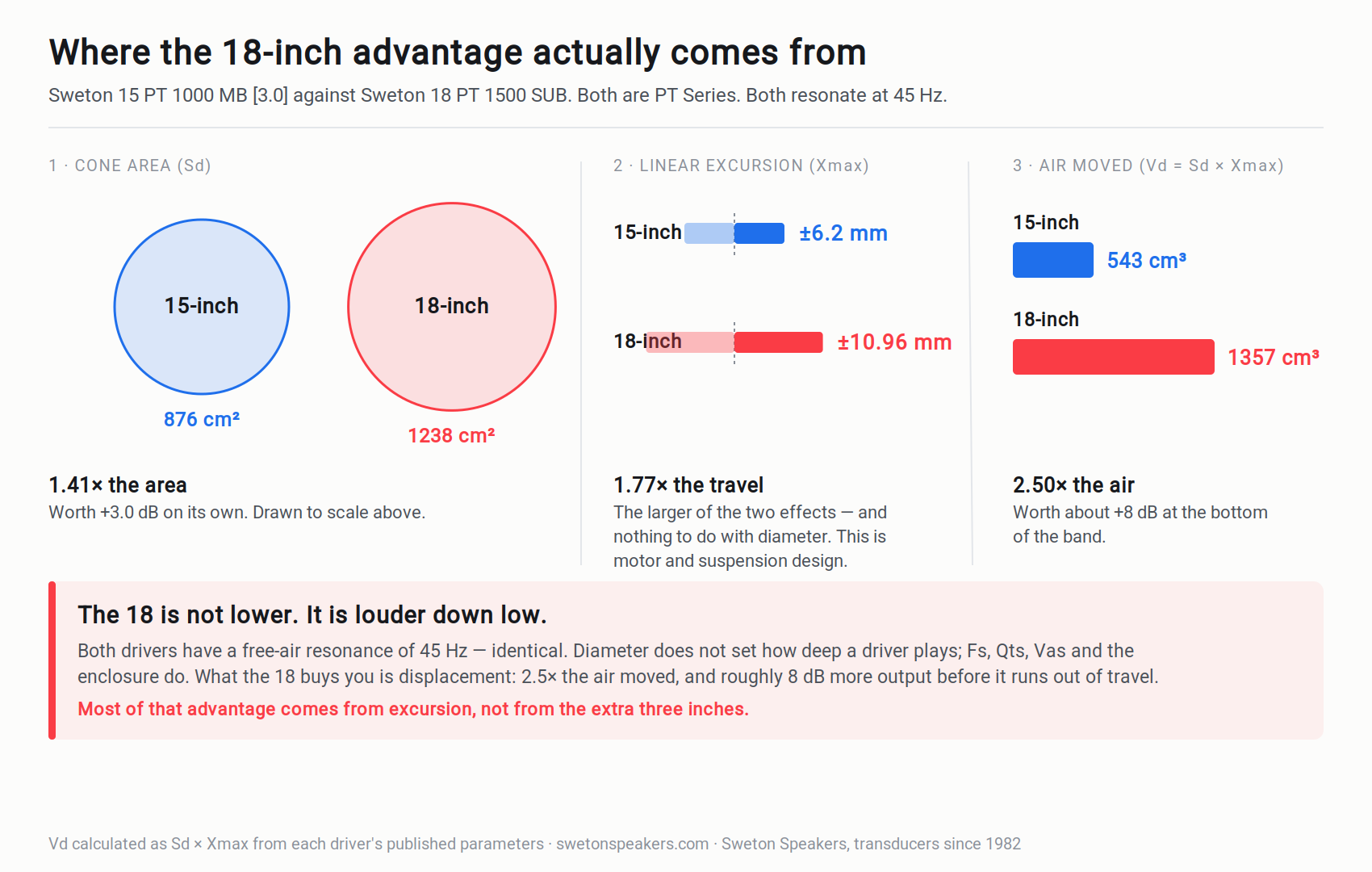
Read the excursion row again. The cone is 1.41× larger. The excursion is 1.77× longer. The larger contribution to displacement comes not from the extra three inches of diameter but from the motor and suspension — how far the voice coil can travel while the magnetic force stays linear. That is engineering, not geometry.
Which is why a well-designed 15-inch driver can genuinely out-perform a poorly designed 18-inch driver, and why comparing two drivers on diameter alone tells you very little.
No — not because of its size. This is the most widespread misconception about loudspeaker sizing, and our own data contradicts it plainly: the 15-inch and the 18-inch above both resonate at 45 Hz.
How deep a driver can usefully play is set by four things, none of which is diameter:
A large driver with a stiff suspension and a high Fs will not play deep. A smaller driver with a heavy cone, a compliant suspension and the right box will. Diameter buys you output, not extension.
This is the question worth answering with arithmetic, because the answer is repeatable for any two drivers you are comparing.
At low frequencies, where a driver is limited by how far it can move rather than by how much heat it can take, maximum output is proportional to displacement. The difference in decibels is:
ΔdB = 20 × log10 (Vd2 / Vd1)
= 20 × log10 (1357 / 543) = 20 × log10 (2.50) ≈ +8 dB
So the 18-inch driver has roughly 8 dB more output available at the bottom of its range before it reaches its excursion limit. To put that in context: 8 dB is a little more than a doubling of perceived loudness, and matching it with 15-inch drivers would take between four and six of them.
Two caveats worth stating, because they are where this arithmetic is misused. It applies in the excursion-limited region — roughly the bottom octave and a half. And it assumes both drivers are in appropriate enclosures; a driver in the wrong box will not reach its theoretical output whatever its displacement.
Two 15-inch drivers beat one 18-inch driver on displacement, and it is not close. Two of our 15-inch drivers give 1086 cm³ against 1357 cm³ for one 18 — so the single 18 still wins on raw displacement, by about 2 dB.
But displacement is not the whole comparison. Doubling the number of cabinets also gives you about 6 dB from acoustic coupling and power handling, so in practice:
The practical answer: if you are choosing between one 18 and two 15s purely for bass output, take the 18 — it is fewer boxes for more output. If the 15s are already doing double duty as tops, the comparison is different and the system design matters more than the driver count.
A 15-inch driver is the most versatile size in professional audio. It has enough cone area to produce serious mid-bass, and it is small and light enough to be carried, flown and transported without special handling.
Typical applications:
Our 15 PT 1000 MB [3.0] is a mid-bass driver rated at 1000 W AES and 2000 W program, with 95 dB sensitivity and a 45–3200 Hz range. That upper limit of 3200 Hz is the point: it can carry midrange up to a compression driver crossover, which an 18-inch subwoofer driver cannot. A 15 is not a small 18 — it is a different tool.
An 18-inch driver is a specialist. It exists to move air at low frequencies, and outside that job it is the wrong choice.
Note the 18 KL 1840 SUB's 40 Hz lower limit against the 18 PT 2000 SUB's 50 Hz. Both are 18-inch drivers. The one rated for less power reaches ten hertz lower. This is the point made earlier, in our own catalogue: extension is a design choice, not a consequence of diameter.
For general PA work — speech, announcements, background and light music — a 15-inch driver is usually the right answer on its own. PA is about intelligibility and even coverage, not about the bottom octave. A sensitive 15 in a well-designed cabinet delivers more usable output per watt than an 18 that spends its capability below the range where speech lives.
Add an 18-inch subwoofer when the system has to carry music as well as voice, or when the room is large enough that the low end needs reinforcing. That is a system decision, not a driver-size decision — which is the distinction the next two sections turn on.
Both, in separate boxes. This is the single most common question we are asked by cabinet builders, and the answer is almost never one size for the whole system.
A DJ or event system has to do two different jobs that pull against each other. It has to reproduce kick and bass at high level for hours, and it has to keep vocals and midrange clear over a crowd. No single driver does both well.
So the standard approach is to split the work: 15-inch drivers in the top boxes handling everything above about 120 Hz, and 18-inch drivers in dedicated bass bins handling everything below. Each driver then operates inside the band it was engineered for.
If you are building your first bass bin, start from the enclosure design you intend to build and the amplifier you already own, then select the driver that suits both. Choosing the driver first and designing the box around it afterwards is the most expensive way to do this.
The most reliable way to size a system is to start from how many people it has to cover, not from a driver specification.
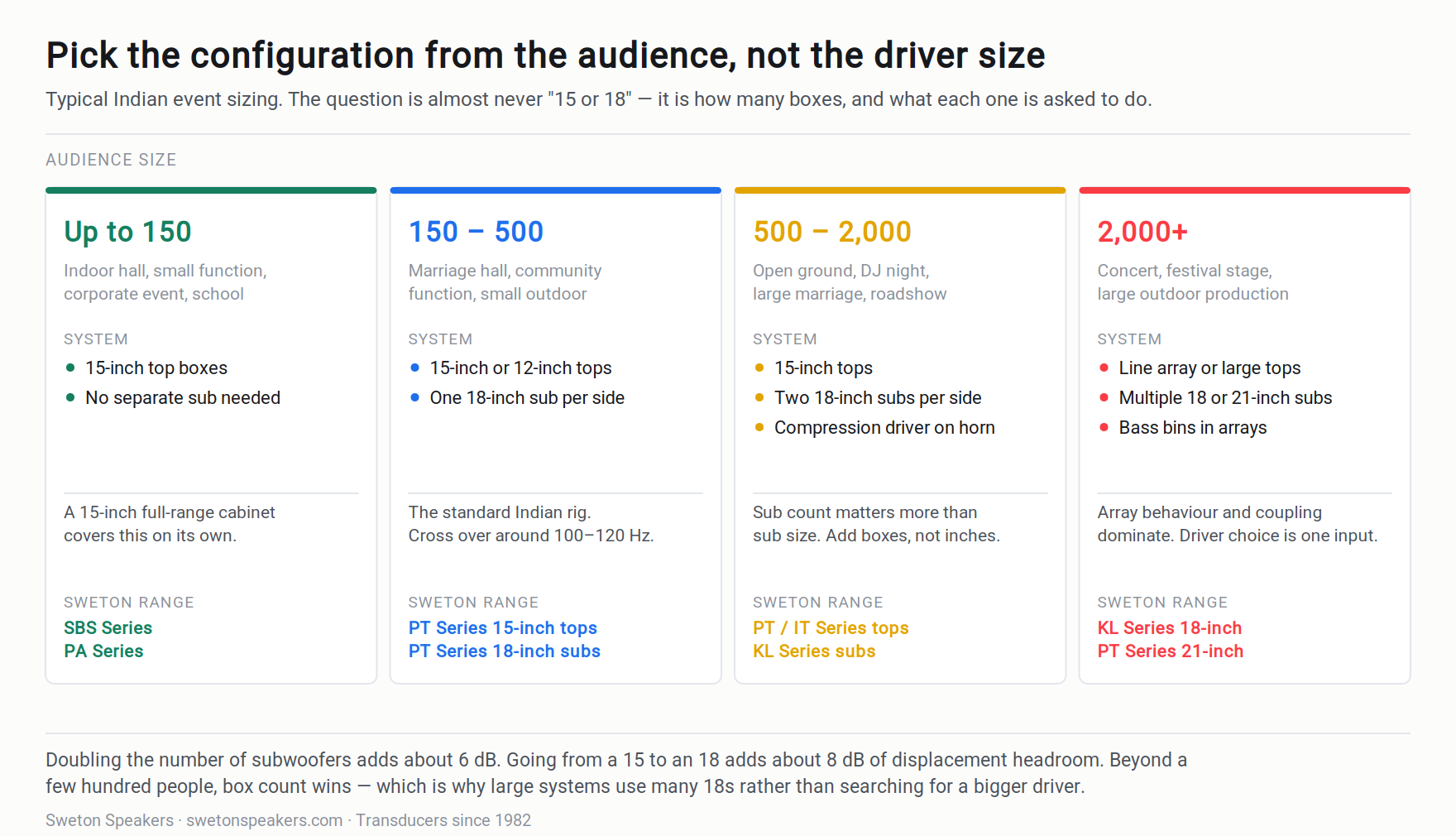
The pattern to notice: as the audience grows, the answer stops being “a bigger driver” and becomes “more cabinets”. Doubling the number of subwoofers adds around 6 dB. Moving from a 15 to an 18 adds around 8 dB of displacement headroom. Past a certain size, box count is simply the cheaper and more controllable way to buy output — which is why large systems use many 18s rather than searching for a bigger driver.
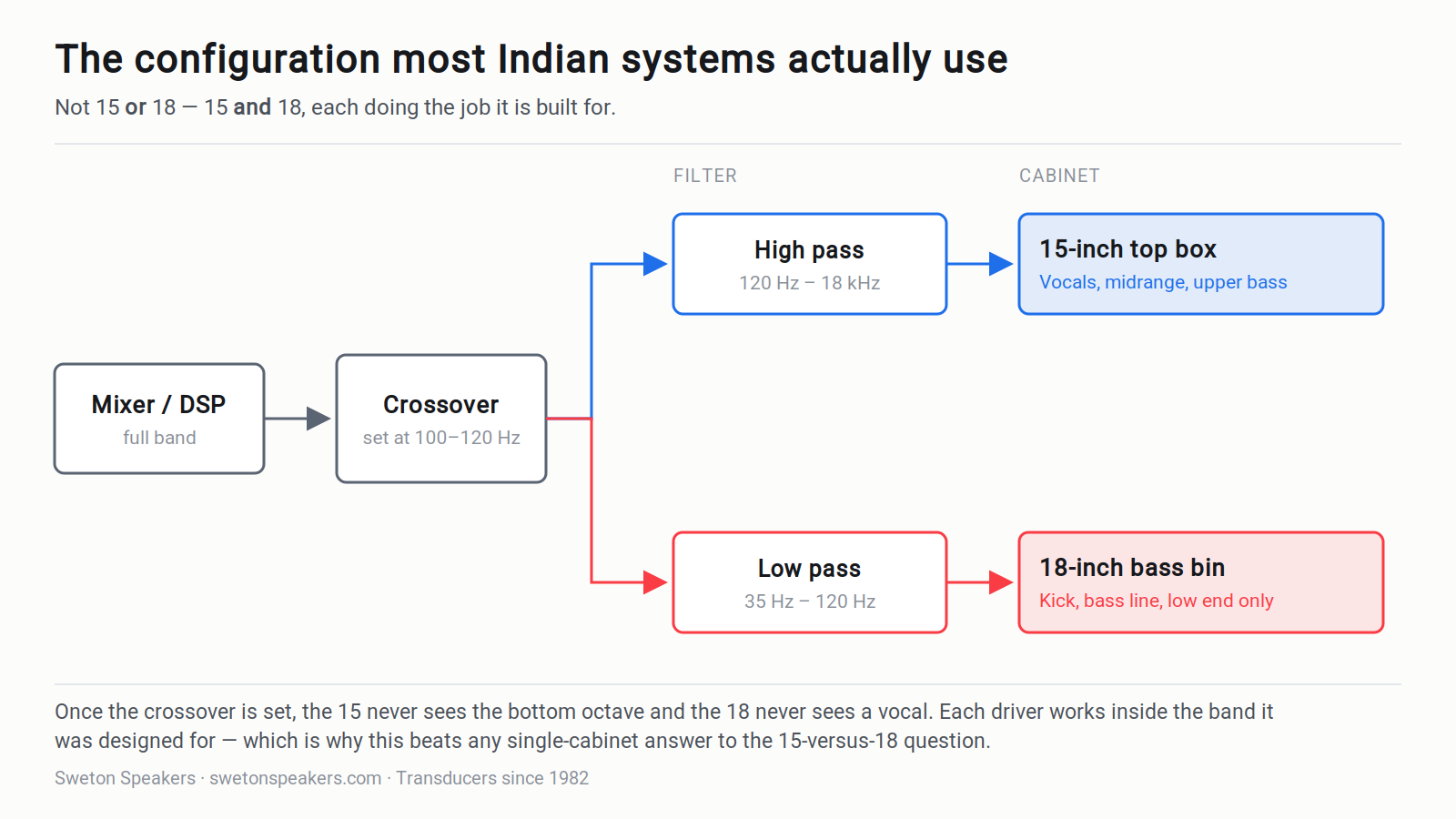
Once the crossover is set, the 15-inch driver never sees the bottom octave and the 18-inch driver never sees a vocal. Two consequences follow, and both are practical:
A driver is not a loudspeaker until it is in a box. The same 18-inch driver in a well-designed vented cabinet and in an undersized sealed one will differ by more than the gap between a good 15 and a good 18.
Bass reflex, sealed, bandpass and horn-loaded designs each suit different drivers, and the Thiele-Small parameters tell you which. Our 18 PT 2000 SUB, for instance, is specified for horn-loaded and bass reflex cabinets — that is part of its intended application, not an afterthought. Check Qts, Vas and EBP against the alignment you plan to build before ordering.
Size the amplifier against the AES rating, not the program or peak figure, and allow headroom above it. Undersizing is not the safe option it appears to be — a clipping amplifier delivers far more high-frequency energy than music does, and that is what destroys drivers.
Nominal impedance is a property of the finished cabinet, not of one driver. Two 8 Ω drivers in parallel present 4 Ω. Work out what the completed system presents before matching an amplifier to it.
The filter points define what each driver is asked to do. Change them and you have changed the requirements on every driver in the system.
Every figure below is published on the individual product page, along with the full Thiele-Small parameter set and mounting dimensions.
Not sure which fits your cabinet? Send us the enclosure volume, the tuning frequency and the amplifier you intend to use, and we will tell you which driver suits — including when the honest answer is that a different size would serve you better.
Stop asking which size is better and start asking what each driver has to do. An 18-inch driver buys displacement — around 8 dB more output at the bottom of the range. A 15-inch driver buys bandwidth, sensitivity and portability. Neither plays deeper than the other by virtue of its diameter, and in most real systems the right answer is one of each, split by a crossover.
When you are comparing two specific drivers, read Sd, Xmax and Fs before you read the diameter. Those three numbers will tell you more in thirty seconds than any amount of argument about inches.
Every specification in this article is published on the relevant product page, measured in our own laboratory. If you are designing a cabinet and want a second opinion on driver selection, send us the enclosure volume, the tuning and the amplifier, and we will tell you what fits.
Next steps
Browse the professional loudspeaker range — PT, KL, IT, PA and SBS Series, compression drivers, crossover networks and amplifiers.
Read how we test — the measurement conditions behind every specification published on this site.
Send us your requirement — enclosure volume, tuning and amplifier, and we will recommend a driver.
Dealership application — for distributors and retailers.
Rahul Agarwal is a partner at Octune Electronics LLP, the manufacturer behind Sweton Speakers, established in Kolkata in 1982. He is an Associate Member of the Audio Engineering Society and trained in Germany on the
Not
automatically. An 18-inch driver moves more air and produces higher output at
low frequencies — around 8 dB more in our own like-for-like comparison. A
15-inch driver covers a wider range, is more portable and is usually more
versatile. They are different tools rather than better and worse versions of
one.


No comments
No comment available for this blog. Be the first to leave a comment!